
High-Performance Signal Conditioning with the Microchip MCP6024 Quad Op-Amp
In the realm of analog electronics, signal conditioning is a critical process that prepares real-world signals for accurate digitization and processing. The Microchip MCP6024 quad operational amplifier stands out as a premier solution for designing high-performance, multi-channel signal conditioning circuits. This article explores the key features and applications of this versatile component.
The MCP6024 integrates four independent op-amps in a single compact package, making it an ideal choice for space-constrained and multi-channel systems. Its defining characteristic is its rail-to-rail input and output operation, which maximizes the dynamic range when operating from low supply voltages, typically from +2.5V to +5.5V. This is particularly crucial in modern systems powered by a single lithium-ion cell or a 3.3V supply rail.
A paramount advantage of the MCP6024 is its low power consumption, with a typical quiescent current of just 1 mW per amplifier. This feature is indispensable for battery-powered and portable instrumentation, enabling extended operational life without sacrificing performance. Furthermore, it exhibits a low input bias current of only 1 pA, which minimizes errors in applications involving high-impedance sensors, such as photodiodes, pH probes, or piezoelectric transducers.
Despite its low-power design, the amplifier does not compromise on speed. With a gain bandwidth product of 10 MHz and a slew rate of 7 V/µs, the MCP6024 can handle a wide range of signals effectively. It is perfectly suited for active filtering, impedance buffering, and amplifying medium-bandwidth signals from sensors in data acquisition systems, automotive electronics, and industrial control modules.
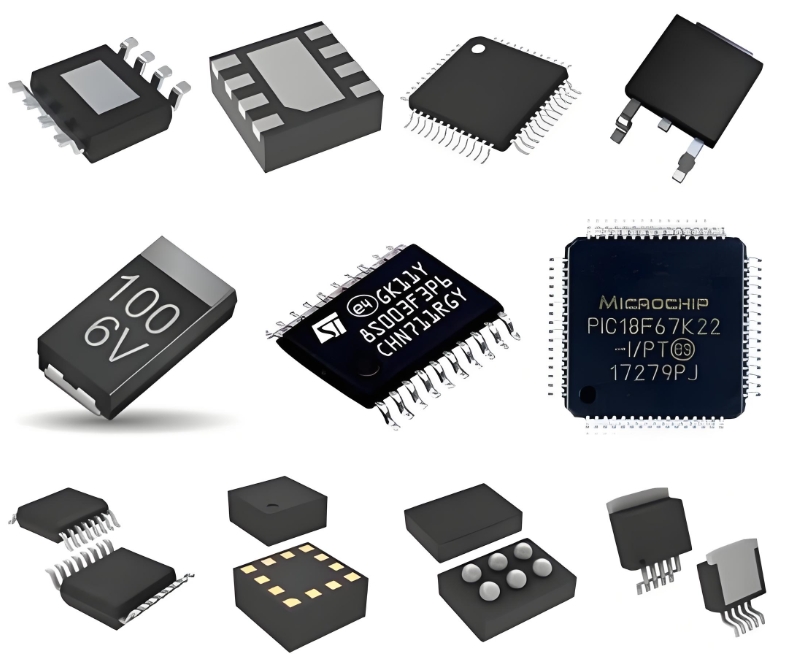
A critical consideration in signal conditioning is maintaining accuracy by minimizing inherent noise. The MCP6024 addresses this with exceptionally low input-referred voltage noise (8.7 nV/√Hz at 10 kHz). This ensures that small analog signals are amplified cleanly without being swamped by the amplifier's own noise, preserving signal integrity from source to ADC.
Typical application circuits include:
Precision Instrumentation Amplifiers: Configuring multiple op-amps to create a high-common-mode-rejection-ratio (CMRR) stage for measuring small differential signals in noisy environments.
Active Anti-aliasing Filters: Implementing Sallen-Key or multiple-feedback (MFB) low-pass filters to remove high-frequency noise before analog-to-digital conversion.
Photodiode Transimpedance Amplifiers (TIAs): Converting the minute current from a photodiode into a robust voltage signal with high linearity and low error.
ICGOODFIND: The Microchip MCP6024 emerges as an exceptional quad op-amp, masterfully balancing low-power operation, rail-to-rail performance, and high precision. Its combination of low noise and low bias current makes it a superior and reliable building block for designing efficient and high-fidelity signal conditioning paths in modern electronic systems.
Keywords: Signal Conditioning, Rail-to-Rail Op-Amp, Low Power Consumption, Low Input Bias Current, Transimpedance Amplifier.

